“We are pleased to be part of this integrated multidisciplinary consortium and hope to create a precedent for future studies where social sciences play an essential role in understanding health.”
Meet the Work Package 9 team, the social sciences team behind the EUmetriosis project. The team is made up of researchers at Wageningen University and the University of Edinburgh, focused on lived experiences of people self-managing endometriosis, soliciting diverse perspectives across Europe.
Providing qualitative, patient-centred approaches to the EUmetriosis project, the team seek to contribute a better understanding of people’s experiences with, and perceptions of self-management. Findings will help shape practical healthcare recommendations for both patients and clinicians, and aim to provide policy insights that will contribute to improvements in care and environments that support the best possible quality of life with the disease.
What is your specific role within the Social Sciences team and how does your expertise contribute to the EUmetriosis project?
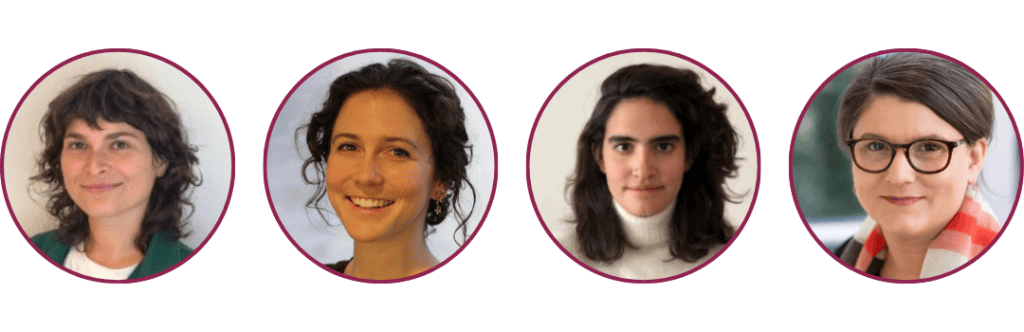
Erica Selznick: I am a PhD student at Wageningen University as part of the EUmetriosis consortium. I aim to document lived experiences, perceptions, and conceptualizations of self-managing endometriosis across diverse identities and backgrounds. Drawing on my public health background, I will examine how structural factors at various levels shape these experiences. This spans across personal, community, and institutional levels, to provide a comprehensive understanding of people’s realities and needs. My goal is to translate qualitative insights into actionable policy recommendations that complement other developments within the EUmetriosis consortium, such as clinical guidelines.
Paula Blancarte Jaber: I am currently undertaking my PhD studies as part of the EUmetriosis project at the University of Edinburgh. My background in clinical medicine gives me insight and an understanding of the topic from a very different perspective than that of social sciences. As part of a social sciences team, this not only gives me a unique perspective on the topic, but it also represents a whole new field for me through which to discover and understand endometriosis and health in general. I am focusing my research on the interaction between medical professionals and patients, and importantly on how the two understand and handle self-management. Currently, little is understood about self-management in general, even less so in relation to endometriosis. Gaining greater understanding of it through the lens of the different stakeholders in the patient journey is key to improve policies, clinical content, and even future research on this important topic.
Dr Andrea Ford: I am a Wellcome Trust Research Fellow at the University of Edinburgh, in the Centre for Biomedicine, Self and Society. As a cultural and medical anthropologist who specialises in women’s health issues, I’m interested in the social structures that influence research and care, as well as the stories, metaphors, and narratives that shape different understandings of bodies. I have conducted ethnographic work on childbearing, endometriosis, period tracking, and the FemTech industry in the US and the UK. My training helps me to understand patterns across these issues, and I bring this contextual thinking to the EUmetriosis project.
Dr Inga Winkler: I’m an Associate Professor in Human Rights in the Department of Social Sciences at Wageningen University, and I lead the Social Sciences Work Package in the EUmetriosis project. With my background in human rights, I am particularly interested in understanding what is needed to create the structural conditions to facilitate self-management to the extent people living with endometriosis consider it helpful in managing the disease.
Why did you want to be involved in this project, what personally or professionally motivated you to take part?
Erica: Endometriosis is a chronic disease that remains particularly overlooked across social, political, and medical spheres, with significant gaps still needing attention. I am fascinated by the gendered aspect of the disease and how it reflects broader stigma and discrimination towards menstruation and women’s health and pain, and how current research and policy often fail to align with lived experiences. I am motivated by the opportunity to explore diverse perspectives and contribute to deeper understanding.
Paula: Ever since interacting with patients living with endometriosis in a clinical setting and learning about it in school, I have always wondered why it doesn’t hold a greater space in healthcare, be it in the educational content, in research or simply in the general knowledge of clinicians. It seems incoherent from any perspective, epidemiological, clinical, financial but most importantly, from a social wellbeing perspective. I’ve been fortunate enough in the past to have the opportunity to work on clinical topics from a patient perspective and collaborate with patient organisations, giving those living with a given disease a space to express themselves and have real influence on their own journey through healthcare. This project and team are working towards a more inclusive and more comprehensive approach to treatment, finally giving endometriosis the importance it deserves within the healthcare research sphere.
Andrea: Endometriosis is a disease that sits at the intersection of several under-researched and poorly understood phenomena that have massive impact on people’s lives and bodies: menstrual cycles, hormonal cycles, gendered forms of chronic disease, inflammation, infertility, stigma. Endometriosis needs more medical research to be funded and conducted, yet because of the social and cultural issues that have kept it obscure, it cannot be “solved” by medical research alone. This is why the EUmetriosis project is so exciting. The opportunity to be part of a genuinely interdisciplinary, collaborative space of research and change-making was my motivation for taking part in this project.
Inga: I have a long-standing research interest in the intersection of health and gender justice and how people’s experiences are shaped by social norms, stigma and societal priorities. Endometriosis is a health condition that primarily affects women and is related to the menstrual cycle. As a result, diagnosis, treatment and care have long been neglected. Many people living with endometriosis have negative experiences with the health care system, and consequently they may see self-management as further abandonment by the system. With our research, we hope to better understand these experiences and perceptions to determine what is needed at the structural level to support people living with endometriosis.
What do you hope your research or involvement will help change for people living with endometriosis?
Inga: Our research goes to the core of how endometriosis is understood and perceived in society. My hope is that our research will make a contribution to understanding the role of self-management, not just as strategies that individuals choose to adopt to improve their quality of life, but as a societal responsibility.
Coming up next: In early February, we’ll be sharing further insight into social science and what we mean when we talk about self-management for endometriosis.